|
Two Marks Upon the Mast
|
I decided to use a DX Engineering 25-foot telescoping fiberglass mast for
my POTA activations. I really like the extra thick walls compared to some
other brands and the cam lock clamps are superior, I think, to the "Twist
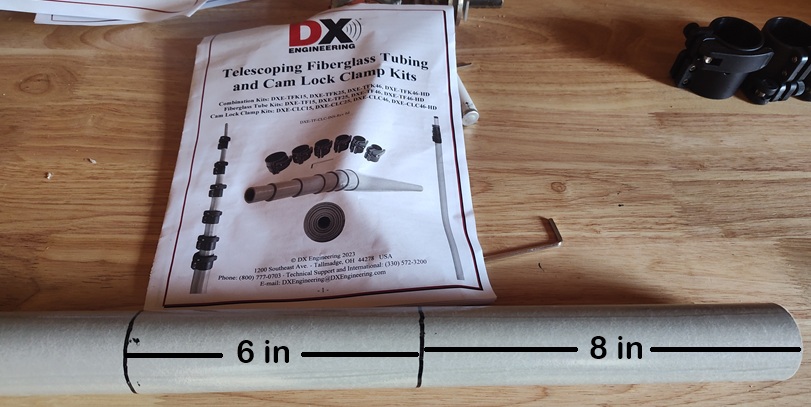
to lock" approach. DXE shows 7-inch overlap at each section, but I went
with 8 inches and drew a line around the mast to know when to stop and lock.
When pulling up each section, it can be easy to overshoot and pull a section
out of the tube below. This can result in nasty problems and words not
suitable for public consumption.
So, I put a second line around the mast that is 6 inches above the stop point.
Seeing this line is like a yellow traffic light: let off the gas - do NOT
pounce on the accelerator to try to beat the light.
|
|
|
Mounting the Shark Ham Sticks
|
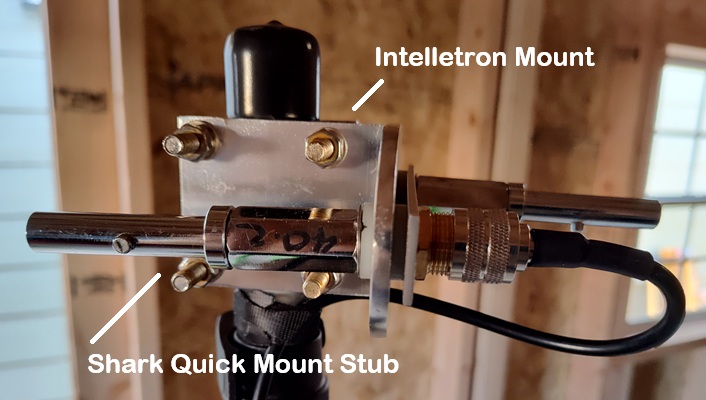
I went to GigaParts to get the Shark Ham Sticks, Shark Quick Disconnect, and the
Intellitron AA-1602 Dipole Antenna Mounting Bracket. The 5-piece set of Disconnects
has one "stub" that screws into a 3/8"x24 mount. The Intellitron has two of those
mounts so it's important to get an additional Shark SH-201L Single Quick Disconnect,
if necessary. It depends on the the number dipoles that you intend to build.
Without the Quick Disconnects, to switch bands would require unscrewing each stick from
its mount and then screwing in the new stick. With the Quick Disconnect, all that's
required is a quick 1/4-turn twist. Of course, the mast must be lowered and raised as
well but this takes little time and caution: POTA is not a race.
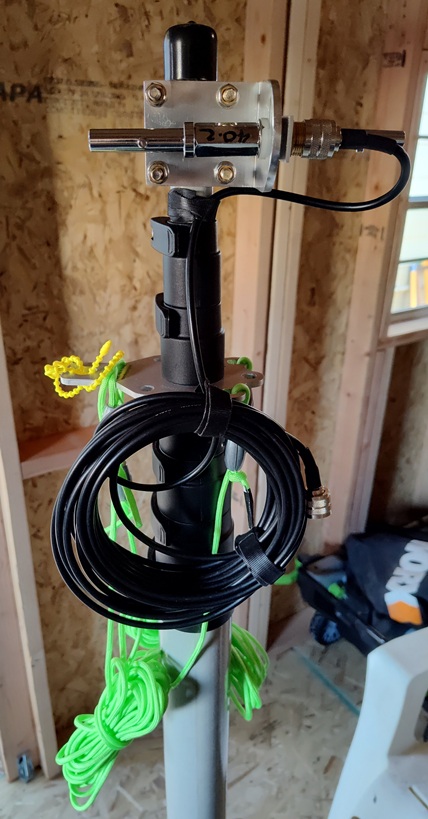
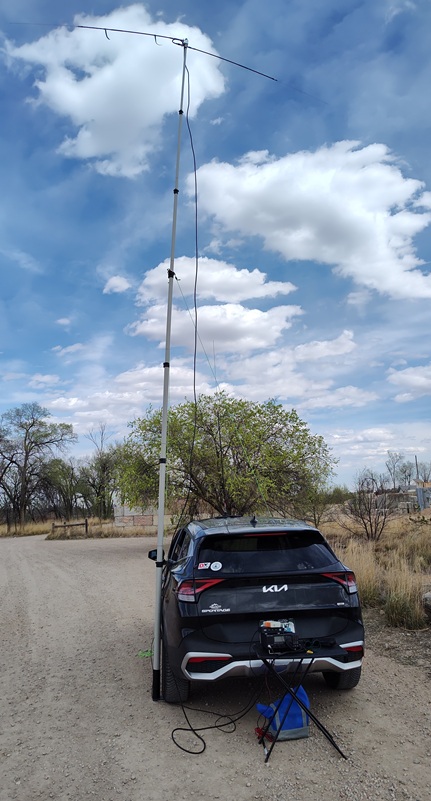
A guy ring is about half-way up. The bright green-yellow ropes are wrapped around the
side-view mirrors or hooked under a bumper. Remember that many parks prohibit even
ground stakes of any kind. "Leave it as you found it" is the Prime Directive. With
the guys, the mast did very well in winds up to 25 mph gusts. I'd go shorter, or not
at all, as needed. An Alphabet Wonders Flagpole Tire Mount from Amazon is used to
mount the mast.
|
|
|
A Initial Comparison between Single Vertical and Dipole Ham Sticks
|
As mentioned above, I had great success using only a single ham stick mounted
vertically on top of the car. With all but 75m, I could get SWR < 2.0 across
the entire SSB phone band. My simple test was to do a POTA activation at Simpson
Ponds SWA (US-11940) mounting the vertical and dipole and switching between the
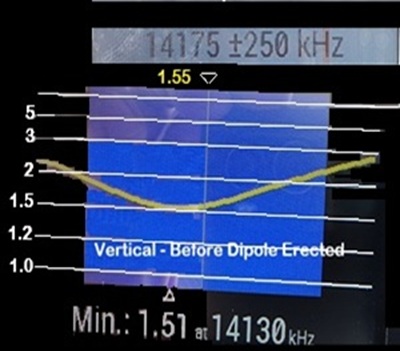
two using an antenna switch. As seen in the RigExpert shots, there was some
definite interaction between the two. For example, the best SWR for the vertical was
significantly higher than when I tuned it in my driveway (1.05) when there was no
mast with dipole on top nor a vertical length of coax for the dipole within a couple
of feet. It was far from a perfect test, but it proved very instructive.
|
|
|
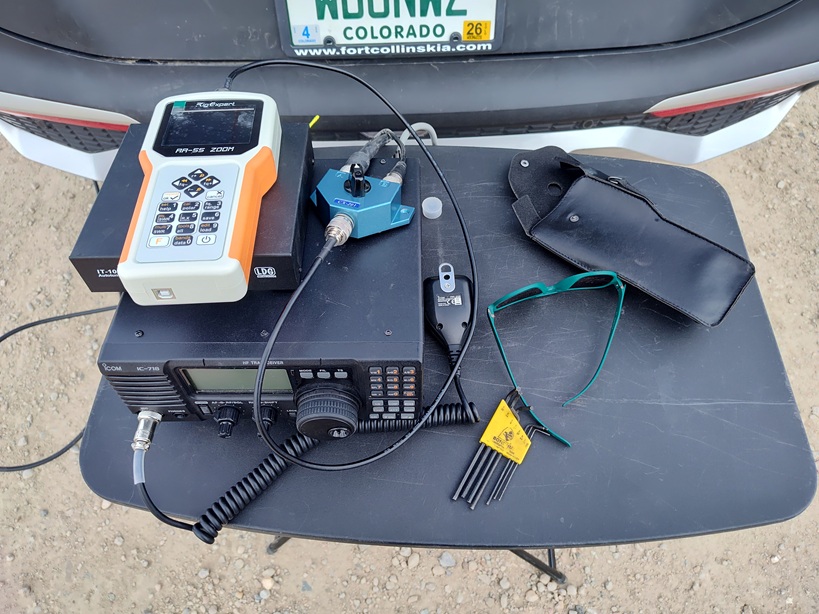
The image above shows the test bench: an IC-718 at 100 watts, an LDG
I-100 tuner, the antenna switch, and a RigExpert. I never thought I could justify
the cost of even a modest antenna analyzer. Now I can't imagine not having one.
|
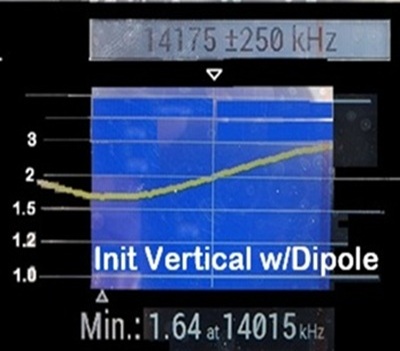
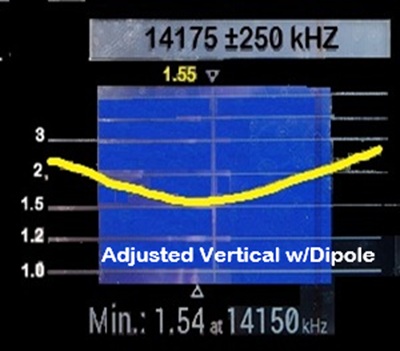
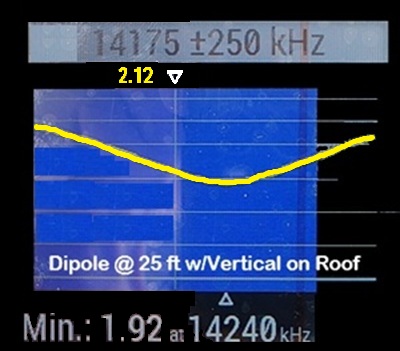
Pardon the poor RigExpert screen shots. I was fighting a bright-sky background. I used
Windows Paint to do a very poor man's effort to make them somewhat reasonable. The blue
region represents the 20m band, centered on 14.175 Mhz and ± 0.25 MHz wide
The left-hand image is the SWR read-out for the vertical mounted on the car as I
would normally use it. The mast has not been mounted, the dipoles are still in the car,
and I've gone directly from the antenna to the RigExpert - not through the switch.
|
|
|
For the right-hand image, the dipole has been mounted and raised. As might be
expected, but not hoped, is that the nearby coax for the dipole and/or the dipole
itself have changed the vertical's characteristics. What's not seen is the change
in radiation pattern for either antenna.
|
The left-hand image shows the SWR for the vertical after shortening the whip about
1 inch. This brought the lowest point near the center of the band. However, the
minimum SWR is not as good as I got in my driveway but at least the SWR is better
than 2:1 across the blue region.
The right-hand image shows the SWR for the dipole at maximum height and the vertical mounted
on top of the car. It's not great, but there's always the LDG tuner to keep the transceiver
side of things happy.
|
|
|
And the Survey Says...
|
Before transmitting, I listened to a couple of stronger POTA activations and switched
between the dipole ("A") and vertical ("B"). In almost every case, "A" was 2-4 S-units
better. Note that the dipole was broadside east-west, i.e., the arms ran north-south.
I found when running only the vertical before these tests, that signals were better
when the magmount was near center on the roof and the car was aimed east-west.
After I started making QSOs, the results were pretty much the same: stations were
reporting an improvement of 2-4 S-units for the dipole versus the vertical. Still, I'd
like to find a way to test the vertical by itself, away from or independent of the
mast/dipole and also to test the dipole, e.g., the effect on the SWR, without the
vertical in the picture.
I do imagine that on extended POTA trips, plans will be a little less ambitious as to
working multiple parks per day. With practice, the mast setup and operator won't take
too much longer, but these tired old arms can raise and lower the mast only so many
times in a day, let alone drive the tens to hundreds of miles between parks.
|
|
I'm Gonna Need a Bigger Boat
|
|
My poor Kia Sportage is stuffed to the gills and that does not include any
luggage or other things if going on a POTA trip with my wife Margaret.
|